what is neomycin and polymyxin b sulfates and dexamethasone ophthalmic suspension used to treat
DESCRIPTION:
Neomycin and Polymyxin B Sulfates and Dexamethasone Ophthalmic Ointment USP is a multiple dose anti-infective steroid combination in sterile ointment form for topical awarding.
The chemic structure for the active ingredient Neomycin Sulfate is:
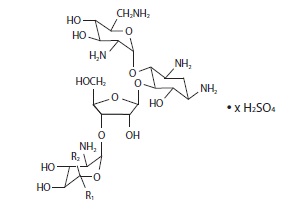
Neomycin B (R1=H, R2=CH2NH2)
Neomycin C (R1=CHiiNHii, Rii=H)
The chemical construction for the active ingredient Polymyxin B Sulfate is:
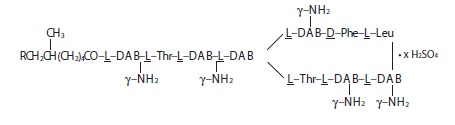
Polymyxin B1 (R=CH3)
Polymyxin B2 (R=H)
DAB= α, γ-diaminobutyric acid
The chemic structure for the active ingredient Dexamethasone is:
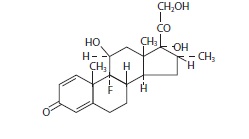
C22H29FO5
MW = 392.47
Established Name: dexamethasone
Chemical Name: pregna-1, 4-diene-3, 20-dione,9-fluoro-xi,17, 21-trihydroxy-xvi-methyl-, ( 11β,16α)-.
Each gram contains: Agile: neomycin sulfate equivalent to neomycin 3.5 mg, polymyxin B sulfate x,000 units, dexamethasone 0.ane%. Inactives: white petrolatum, mineral oil.
CLINICAL PHARMACOLOGY:
Corticosteroids suppress the inflammatory response to a diversity of agents and they probably delay or tiresome healing. Since corticosteroids may inhibit the body's defense machinery confronting infections, a concomitant antimicrobial drug may be used when this inhibition is considered to be clinically significant in a particular case.
When a decision to administer both a corticosteroid and an antimicrobial is made, the assistants of such drugs in combination has the advantage of greater patient compliance and convenience, with the added balls that the appropriate dosage of both drugs is administered, plus assured compatibility of ingredients when both types of drugs are in the same formulation and, particularly, that the correct volume of drug is delivered and retained.
The relative potency of corticosteroids depends on the molecular structure, concentration and release from the vehicle.
INDICATIONS AND USAGE:
For steroid-responsive inflammatory ocular conditions for which a corticosteroid is indicated and where bacterial infection or a risk of bacterial ocular infection exists.
Ocular steroids are indicated in inflammatory atmospheric condition of the palpebral and bulbar conjunctiva, cornea, and inductive segment of the globe where the inherent risk of steroid utilise in sure infective conjunctivitides is accepted to obtain a diminution in edema and inflammation. They are also indicated in chronic anterior uveitis and corneal injury from chemic, radiations or thermal burns; or penetration of foreign bodies.
The use of a combination drug with an anti-infective component is indicated where the run a risk of infection is loftier or where there is an expectation that potentially dangerous numbers of bacteria will be present in the middle.
The particular anti-infective drug in this product is agile against the following mutual bacterial centre pathogens:
Staphylococcus aureus, Escherichia coli, Haemophilus influenzae, Klebsiella/Enterobacter species, Neisseria species, and Pseudomonas aeruginosa.
This product does non provide adequate coverage against: Serratia marcescens and Streptococci, including Streptococcus pneumoniae.
CONTRAINDICATIONS:
Neomycin and polymixin B sulfates and dexamethasone opthalmic ointment is contraindicated in epithelial herpes simplex keratitis (dendritic keratitis), vaccinia, varicella, and many other viral diseases of the cornea and conjunctiva. Mycobacterial infection of the heart. Fungal diseases of ocular structures. Neomycin and polymixin B sulfates and dexamethasone opthalmic ointment is likewise contraindicated in individuals with known or suspected hypersensitivity to a component of the medication. (Hypersensitivity to the antibiotic component occurs at a higher rate than for the other components.)
WARNINGS:
Non FOR INJECTION. Use of ocular steroids may prolong the class and may exacerbate the severity of many viral infections of the heart (including herpes simplex). Employment of steroid medication in the treatment of herpes simplex requires great circumspection; frequent slit lamp microscopy is recommended.
Prolonged use may event in glaucoma, with damage to the optic nerve, defects in visual acuity and fields of vision, and posterior subcapsular cataract formation. Prolonged employ may suppress the host response and thus increment the gamble of secondary ocular infections. In acute purulent conditions or parasitic infections of the eye, steroids may mask infection or enhance existing infection.
In those diseases causing thinning of the cornea or sclera, perforations have been known to occur with the use of topical steroids.
If this production is used for x days or longer, intraocular pressure (IOP) should be routinely monitored fifty-fifty though it may be difficult in children and uncooperative patients. Steroids should be used with caution in the presence of glaucoma. IOP should be checked frequently.
The use of steroids after cataract surgery may delay healing and increase the incidence of bleb formation.
Products containing neomycin sulfate may cause cutaneous sensitization. Sensitivity to topically administered aminoglycosides, such equally neomycin, may occur in some patients. Severity of hypersensitivity reactions may vary from local effects to generalized reactions such every bit erythema, itching, uticaria, skin rash, anaphylaxis, anaphylactoid reactions, or bullous reactions. If hypersensitivity develops during utilise of the product, treatment should be discontinued. Cross-hypersensitivity to other aminoglycosides can occur, and the possibility that patients who go sensitized to topical neomycin may also be sensitive to other topical and/or systemic aminoglycosides should exist considered.
PRECAUTIONS:
General: The initial prescription and renewal of the medication order across 8 grand of neomycin and polymixin B sulfates and dexamethasone opthalmic ointment should exist made by a md only subsequently exam of the patient with the aid of magnification, such every bit slit lamp biomicroscopy and, where advisable, flourescein staining.
The possibility of persistent fungal infections of the cornea should be considered afterwards prolonged steroid dosing. Fungal infection should exist suspected in patients with persistent corneal ulceration.
Data for Patients: If inflammation or pain persists longer than 48 hours or becomes aggravated, the patient should exist brash to discontinue use of the medication and consult a physician.
This production is sterile when packaged. To preclude contamination, care should be taken to avoid touching the tube tip to eyelids or to any other surface. The use of this tube past more than one person may spread infection. Continue tube tightly closed when not in use. Keep out of attain of children.
Patients should be advised that their vision may be temporarily blurred following dosing with neomycin and polymyxin B sulfates and dexamethasone ophthalmic ointment. Care should be exercised in operating machinery or driving a motor vehicle.
Carcinogenesis, Mutagenesis, Impairment of Fertility: Long-term studies in animals to evaluate carcinogenic or mutagenic potential have not been conducted with polymyxin B sulfate. Treatment of cultured human lymphocytes in vitro with neomycin increased the frequency of chromosome aberrations at the highest concentration (80 μg/mL) tested. Even so, the effects of neomycin on carcinogenesis and mutagenesis in humans are unknown. Polymyxin B has been reported to impair the motility of equine sperm, but its effects on male or female fertility are unknown.
Pregnancy:
Dexamethasone has been shown to be teratogenic in mice and rabbits following topical ophthalmic awarding in multiples of the therapeutic dose.
In the mouse, corticosteroids produce fetal resorptions and a specific abnormality, cleft palate. In the rabbit, corticosteroids have produced fetal resorptions and multiple abnormalities involving the head, ears, limbs, palate, etc.
There are no adequate or well-controlled studies in pregnant women. However, prolonged or repeated corticoid use during pregnancy has been associated with an increased gamble of intra-uterine growth retardation. Neomycin and polymyxin B sulfates and dexamethasone ophthalmic ointment should be used during pregnancy only if the potential benefit to the mother justifies the potential risk to the embryo or fetus. Infants born of mothers who accept received substantial doses of corticosteroids during pregnancy should be observed advisedly for signs of hypoadrenalism.
Nursing Mothers: Systemically administered corticosteroids appear in human milk, could suppress growth, interfere with endogenous corticosteroid production, or cause other untoward effects. It is not known whether topical assistants of corticosteroids could result in sufficient systemic assimilation to produce detectable quantities in human milk. Because many drugs are excreted in human milk, caution should exist exercised when neomycin and polymyxin B sulfates and dexamethasone ophthalmic ointment is administered to a nursing adult female.
Pediatric Use: Rubber and effectiveness in pediatric patients have non been established.
Geriatric Use: No overall clinical differences in prophylactic or effectiveness take been observed betwixt the elderly and other developed patients.
ADVERSE REACTIONS:
Adverse reactions have occurred with steroid/anti-infective combination drugs which tin be attributed to the steroid component, the anti-infective component, or the combination. Exact incidence figures are not available since no denominator of treated patients is bachelor.
Reactions occurring about often from the presence of the anti-infective ingredients are allergic sensitizations. The reactions due to the steroid component are: elevation of IOP with possible development of glaucoma, and exceptional optic nerve damage; posterior subcapsular cataract formation; and delayed wound healing.
Secondary Infection: The development of secondary infection has occurred after use of combinations containing steroids and antimicrobials. Fungal infections of the cornea are particularly prone to develop coincidentally with long-term applications of steroid. The possibility of fungal invasion must be considered in whatever persistent corneal ulceration where steroid handling has been used. Keratitis, conjunctivitis, corneal ulcers, and conjunctival hyperemia have occasionally been reported following apply of steroids. Secondary bacterial ocular infection following suppression of host responses likewise occurs.
Boosted adverse reactions identified from post marketing use include ulcerative keratitis, headache, and Stevens-Johnson syndrome.
To written report SUSPECTED ADVERSE REACTIONS, contact Perrigo at 1-866-634-9120, or FDA at 1-800-FDA-1088 or www.fda.gov/medwatch.
DOSAGE AND ADMINISTRATION:
Utilize a minor corporeality into the conjunctival sac(s) up to three or four times daily.
How to Utilize neomycin and polymyxin B sulfates and dexamethasone ophthalmic ointment:
1. Tilt your head back.
2. Place a finger on your cheek merely under your centre and gently pull down until a "V" pocket is formed between your eyeball and your lower lid.
iii. Identify a small corporeality (most 1/2 inch) of neomycin and polymyxin B sulfates and dexamethasone ophthalmic ointment in the "V" pocket. Do not let the tip of the tube touch your eye.
4. Await downwards earlier closing your center.
Not more than 8 g should be prescribed initially and the prescription should non be refilled without farther evaluation equally outlined in PRECAUTIONS to a higher place.
HOW SUPPLIED:
Neomycin and polymixin B sulfates and dexamethasone ophthalmic ointment USP is supplied in 3.5 1000 (1/8 oz) sterile tamper axiomatic tubes with ophthalmic tip. (NDC 0574-4160-35).
STORAGE: Store at 20°-25°C (68°-77°F) [meet USP Controlled Room Temperature].
Manufactured For Perrigo
Minneapolis, MN 55427 1R200 RC J4 Rev 02-18 CD Ini 1113 R0218
PRINCIPAL Display PANEL - Carton
Rx Just
NDC 0574-4160-35
Neomycin and Polymyxin B
Sulfates and Dexamethasone
Ophthalmic Ointment USP
NET WT 3.5 g (i/8 oz)
STERILE
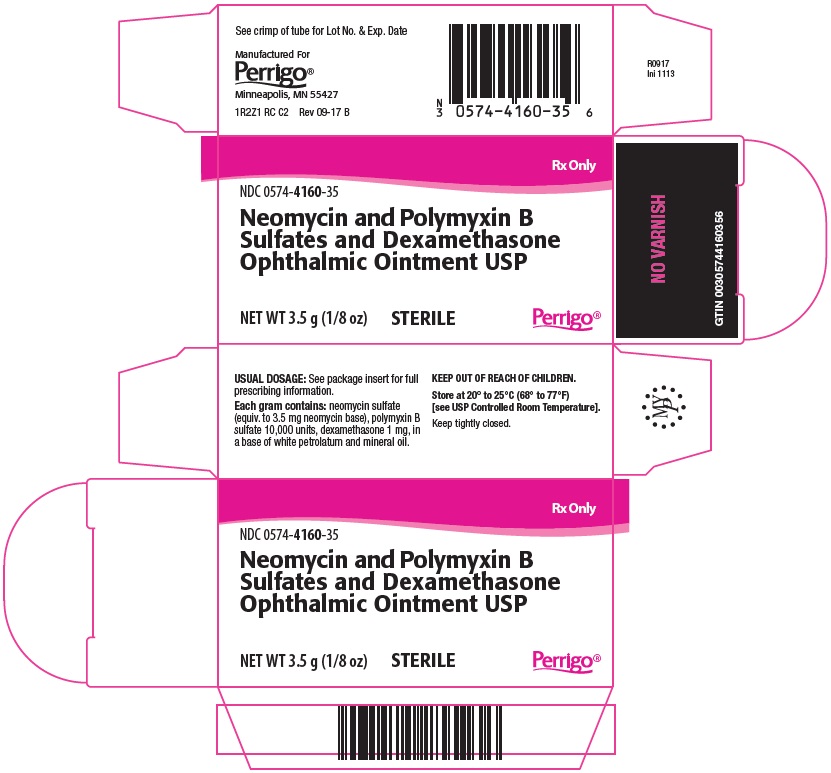
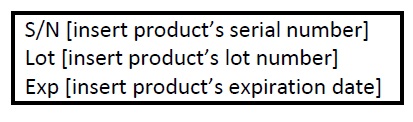
The post-obit image is a placeholder representing the production identifier that is either affixed or imprinted on the drug packet label during the packaging operation.
browningadven1977.blogspot.com
Source: https://dailymed.nlm.nih.gov/dailymed/fda/fdaDrugXsl.cfm?setid=c8ae4afe-4f06-4441-9c5b-52f485f8f2f5
0 Response to "what is neomycin and polymyxin b sulfates and dexamethasone ophthalmic suspension used to treat"
Enregistrer un commentaire