Barberã¢ââ¢s Adagio for Strings Ordway Center for the Performing Arts December 1
Barber's Adagio for Strings
Details
 Watch Video
 Caroline Shaw
Entr'acte
Entr'acte was written in 2011 after hearing the Brentano Quartet play Haydn'due south Op. 77 No. 2 — with their spare and soulful shift to the D-apartment major trio in the minuet. Information technology is structured like a minuet and trio, riffing on that classical form only taking it a little further. I beloved the way some music (similar the minuets of Op. 77) suddenly takes you to the other side of Alice's looking drinking glass, in a kind of absurd, subtle, technicolor transition.
Caroline Shaw ©2017
 Listen to Audio
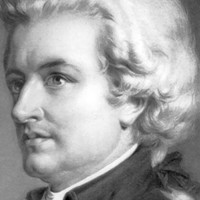
 Wolfgang Amadeus Mozart
Violin Concerto No. iii in One thousand
Mozart'due south childhood feats at the keyboard overshadowed some other of his nifty talents: playing the violin. His father was an influential teacher and the author of a seminal volume on violin technique, so information technology figured that Mozart would pick upward stringed instruments. (He also had a special affection for the viola, playing information technology in chamber music situations throughout his life.) Mozart wrote 5 violin concertos, all during his teenage years, when his official position had him working alongside his father in the service of Salzburg'due south archbishop. With no record of whatever other performer or commission involved, we can surmise that Mozart wrote the violin concertos with the intention of performing the solo parts himself. Such works, forth with the many symphonies, serenades and divertimentos from that time, were perfect fare for the side gigs he booked entertaining Salzburg'southward wealthy families.
The violin writing in the Third Violin Concerto's opening Allegro motility is full of three-notation chords, in both the solo part and the orchestra. The chords give the main theme extra panache and power, and their idiomatic voicings bear witness that Mozart knew how to achieve maximum effect on his secondary instrument.
Out of all five of Mozart's violin concertos, this piece of work's primal Adagio is the only motility in which 2 flutes supersede the oboes. (Presumably the oboists in Salzburg doubled on flute.) The solo violin's long, arcing phrases sound like they could come from the oral cavity of an operatic soprano; there is even a bit of a "diva" moment when the violin intrudes on the orchestra's terminal coda to offer ane terminal argument of the principal theme.
In the Rondeau finale, one of the contrasting sections borrows a folk tune from the vicinity of Strasbourg, virtually the border between France and Germany, leading Mozart and others to dub this the "Strassburger" Concerto. Droning double-stops and folksy little contribute to the local color.
Aaron Grad ©2017
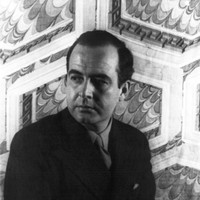
Samuel Barber
Adagio for Strings
Samuel Hairdresser enrolled in the founding form at Philadelphia's Curtis Constitute of Music at the age of xiv. He went on to win the American University's prestigious Rome Prize, which bankrolled his Italian residency from 1935–1937. During that time, Hairdresser equanimous his Cord Quartet (Opus eleven) besides as an accommodation for string orchestra of the quartet's slow movement, a haunting Adagio that was destined to become i of the most recognizable compositions of the century.
The string orchestra version of the Adagio made its public debut in 1938 during a radio broadcast by Arturo Toscanini and the NBC Symphony Orchestra. The work became an instant favorite with the public, and its success launched Barber'south international career.
The first significant use of the Adagio as music for mourning came in 1945, when radio stations circulate the work following the annunciation of Franklin D. Roosevelt's death. The tradition continued with performances at the funerals of John F. Kennedy, Grace Kelly and Leonard Bernstein, amidst many others. More recently, the Adagio has been used to memorialize victims of the September 11th terrorist attacks, nigh notably in a televised performance at the BBC Proms on September fifteen, 2001. The score has also appeared in many films, from its wrenching role in Platoon to a sardonic cameo in Amélie. The championship of a 2010 book by Thomas Larson on the Adagio sums upward the place this music has come to occupy in our collective consciousness: The Saddest Music Ever Written.
The musical language of Barber's Adagio is deceptively simple. Melodically, lines move in long strands of smooth steps; the primary melodic motive is a group of three rising notes, evoking a sense of reaching and yearning. Harmonically, the free energy builds through drawn-out suspensions, creating momentary surges of tension and release over a glacially deadening sequence of bass notes. It is a simple and elegant pattern, i that evokes as much emotion, notation-for-note, as any slice of music in recorded history.
Aaron Grad ©2017
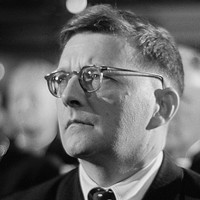
Dmitri Shostakovich
Chamber Symphony in D Pocket-size
In 1948, when the Soviet government released a notorious prescript attacking "formalism" in music, Dmitri Shostakovich topped the listing of censured composers. He had bounced back from a similar public humiliation orchestrated by Stalin in 1936, just this renewed crackdown persisted. Shostakovich lost his kinesthesia position at the Moscow Conservatory, and his main public duties in the following years consisted of keeping up appearances at international conferences and writing picture scores and patriotic music. He continued his serious composing in private, stashing major new works—including the Outset Violin Concerto and the Fourth and Fifth String Quartets—for later performances.
Stalin died on March five, 1953, and the Soviet Wedlock entered a period of "thaw" under Nikita Khrushchev. Shostakovich's longtime collaborators, the Beethoven Quartet, premiered the Fifth Quartet that November, and just weeks afterwards they introduced the Fourth Quartet, a work that had waited four years for a first performance.
Rudolf Barshai, a Russian conductor and friend of Shostakovich, obtained the composer's blessing to create this alternating arrangement of the Fourth Quartet, published as the Chamber Symphony, Op. 83a. The Allegretto first movement begins with an extended drone, its pressure mounting under folk-like melodies and serpentine counterpoint. The Andantino follows with a sweetness, songlike tune, scored first for oboe over pulsing cord accompaniment. The third movement is a whispered scherzo that takes on a militaristic character with an orchestration featuring trumpets and percussion.
A bassoon solo connects directly to the finale. There are stiff traces in this movement of Jewish folk music, a source that Shostakovich turned to in a number of works during that period, including the Second Pianoforte Trio from 1944 and the song cycle From Jewish Folk Poetry from 1948. If we take the give-and-take of Testimony, the memoirs dictated to (or possibly fabricated by) Solomon Volkov, Shostakovich appreciated that Jewish folk music "tin appear to exist happy while information technology is tragic. Information technology is most always laughter through tears."
Aaron Grad ©2017
About This Program
Approximate length 2:00
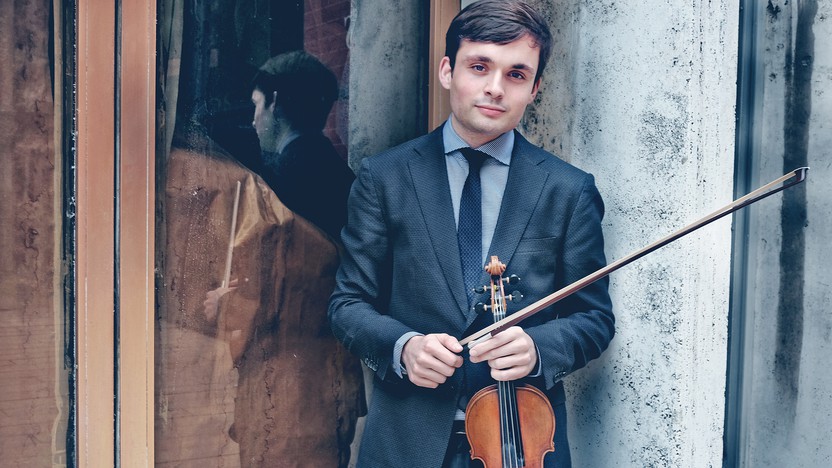
Guided by the talents of Joshua Weilerstein and the SPCO's own Francisco Fullana, this plan explores the broad reaching emotional resonance of works for string soloists and ensembles. Hairdresser and Shostakovich's expressive contributions bookend Earth War 2, with the American Hairdresser writing from a troubled Europe in the belatedly 1930s and Shostakovich composing under the authoritarian gaze of Stalin'southward Soviet Union in the tardily 1940s. Brooklyn-based Caroline Shaw's Entr'acte finds gimmicky energy in the 18th-century musical ideas that informed the vigorous Viennese innovation in Mozart's third Violin Concerto.
browningadven1977.blogspot.com
Source: https://content.thespco.org/events/barbers-adagio-strings/
0 Response to "Barberã¢ââ¢s Adagio for Strings Ordway Center for the Performing Arts December 1"
Enregistrer un commentaire